
Why are people so fucking mean about food?
All over social media, people are getting in fights about food. I see it everyday and it is disheartening. One of my Instagram friends, Dr. Christina Sciarrillo (who is truly the best follow and such a wealth of knowledge) posted a video de-bunking a claim about how Coca-Cola being sweetened with cane sugar instead of HCFS (high fructose corn syrup) was not a nutritional “win” as they are both high in added sugar and low in nutrients.
Here is the post:
I am not going to get into the details about why she is correct, but I want to a series of comments from a particular user…. They start with this comment:
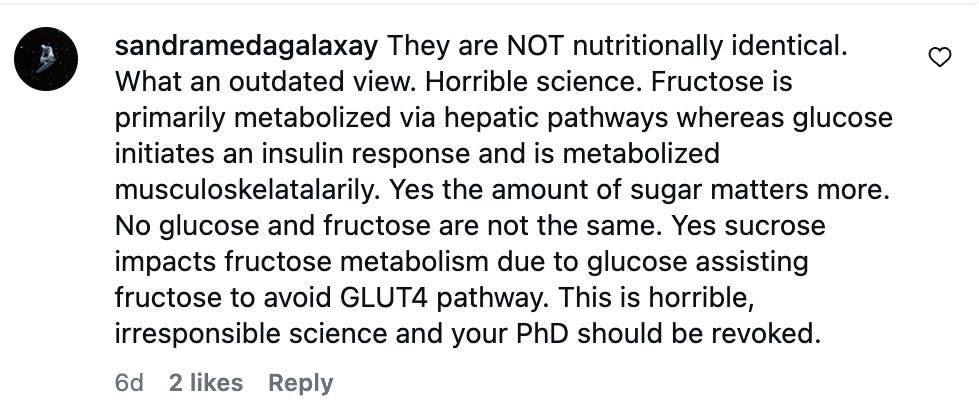
This is a big reaction to have to an Instagram post (a post that is completely correct, but I digress…). Stating that Dr. Sciarrillo’s PhD should be revoked for making a (true) statement online is wildly inappropriate. The comments only become more and more cruel as we go on… I won’t add all of them but here are a few choice outtakes:
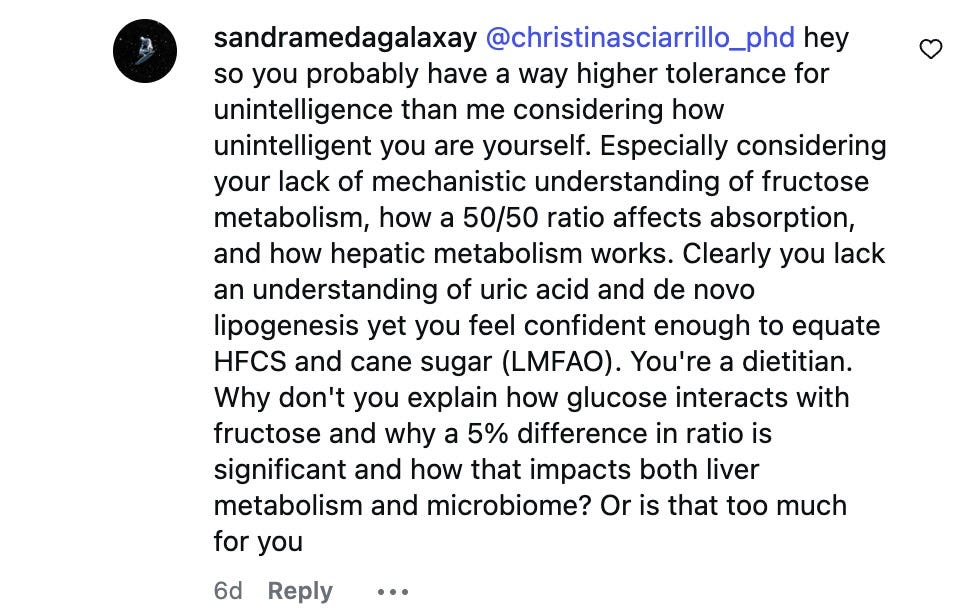
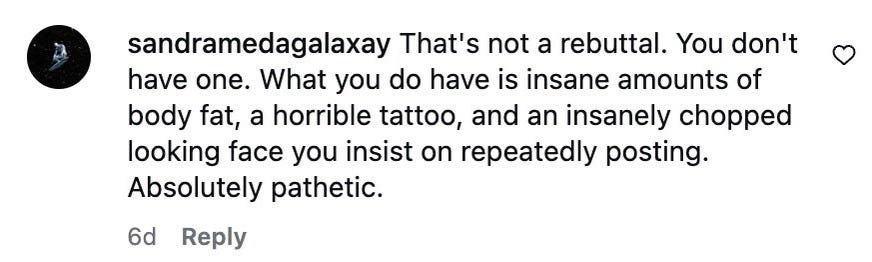
What is it about nutrition discussion that brings out this side of people?
Insulting someone’s appearance based on a nutrition opinion? There is discourse like this all over the internet whether it be about Carnivore vs. Plant Based, Seed oils, Dairy, Gluten, Sugar. People aren’t just disagreeing here, they are defending something deeply personal.
The problem is that many people have made their diet their identity.
I think people respond like this because it feels personal. When they hear “you’re incorrect” they are feeling invalidated, on a personal level.
Your diet isn’t your identity , but even the language we use around eating can further perpetuate this idea…
“I’m gluten-free.” “I’m dairy-free” “I’m paleo”
You are a person, not a diet. The way you eat is a behavior, not your personality.
We are confusing behaviors with identities. Eating a vegan diet, avoiding gluten, tracking macros, or practicing intermittent fasting are all behaviors. They’re things you do, not who you are. When we start treating them as identities, it becomes much harder to evaluate them objectively. A suggestion to change your eating pattern no longer feels like guidance, it feels like a personal attack. And that’s where people get stuck. You can change the way you eat without changing who you are inherently.
Identity is much harder to change than behavior. This is actually why I encourage my clients to create an identity of themselves as a “healthy person” through their own behaviors. This makes it more difficult to stop the behaviors when they are part of your identity. But what if the behaviors aren’t actually healthy? This is where we get into trouble. We have to be able to look at our behaviors (without bias) and see if they are actually driving us toward our goals, if they are actually improving our health- or if we have just made them such a big part of our identity we can’t let them go.
This is especially concerning when someone who has assigned morality and identity to eating behavior is working as a provider of any type in the nutrition space. It is part of our ethical duty to remain objective and unbiased about interventions, and to follow the science with our patient’s best interests at heart. The danger lies in the fact that once food choices become tied to morality, identity, intelligence, discipline, or worth, it becomes very difficult to objectively evaluate them.
When you have built your identity around being someone who “eats clean” or “low-carb” or “fasting”- what happens when a different approach might actually help you more? In your mind It’s no longer a discussion about nutrition, it feels like a discussion about whether you’re a good, smart, or worthy person. I think that is why people get so defensive.
Eating a certain way doesn’t make you a better person, or a worse person. Eating processed foods doesn’t make you lazy. Eating organic foods doesn’t make you virtuous. Body size isn’t a measure of your morality. Neither is diet. But judging people based on how they eat or the size of their body? Being mean to someone online because they have different beliefs than you do? That says a lot about your character. More than any food choice ever will.
Attacking someone online has never changed their beliefs. If anything, it usually causes people to dig their heels in even deeper. While science gives us a lot of clear information, there’s still plenty we don’t know. Nutrition research is notoriously difficult to conduct (more on that below), and there will always be individual differences, unique experiences, and people whose bodies respond differently than expected. That’s why these conversations require curiosity and humility from all of us. Even when I think someone is wrong, I try to ask more questions. What do they value? What experiences have shaped their beliefs? What might I be missing?
That still doesn’t mean every opinion is equally valid. Someone with years of formal training in nutrition is likely to have a more complete understanding than someone who graduated from Instagram University or has simply “dOnE tHeIr OwN rEsEaRcH.” Expertise matters. But learning happens when we’re willing to listen, not when we’re busy insulting each other. And as a general rule, the more extreme a nutrition claim sounds, the less likely it is to be true, or useful.
Nutrition is a science, not an opinion.
Nutrition isn’t a belief system, it is a science. Meaning it is organized, and well studied with lots of guardrails in place. Nutrition research is notoriously difficult to conduct, because there are many confounding variables like sleep, exercise, socioeconomic status, and more. Dietary measurements are inherently inaccurate and difficult to control. There is no self-reporting tool that is truly unbiased. Blinding in a study is almost impossible, unlike a study where you take a drug or a placebo. Our diet operates over decades, not weeks, and long-term RCT’s are even more difficult to control. Food is also complex, and unlike pharmaceuticals, we can’t isolate specific molecules from food- they also interact with other molecules in the food (synergy of food), as well as each individual’s gut microbiome, genetics, and metabolic status. All of this is to say, Nutrition science is a nuanced and evolving field. This is why, as a Registered Dietitian, I am always doing continuing education (we are required) to stay up to date on the latest information.
Science requires us to update our beliefs when new information becomes available. And if you aren’t willing to do this, if you aren’t willing to see evidence and reevaluate your beliefs, then you are potentially missing out on improvements to your health.
The goal isn’t to be “right” - the goal is to be the best version of yourself. Being successful with nutrition requires flexibility, the ability to work with what is available to you at any given time. And the people who are the most successful with nutrition are willing to challenge their assumptions, to try something new, and to update their beliefs when evidence changes.
So why are people so fucking mean about food online?
Because when a way of eating becomes part of your identity, a challenge to that way of eating feels like a challenge to you. A discussion about food suddenly feels like a discussion about your intelligence, discipline, morality, or worth. And when people feel personally threatened, they get defensive.
That’s how we end up with people attacking someone’s appearance over a discussion about sugar. That’s how we end up fighting over seed oils, gluten, dairy, and carbohydrates like we’re defending a sports team.
Maybe if people’s identities weren’t so wrapped up in how they eat, they wouldn’t respond to nutrition discussions with anger and vitriol. Maybe they’d respond with curiosity, with open ears and an open mind. Maybe they’d learn something new, consider a different perspective, or discover an approach that could actually improve their health. I know this was my experience going through all of my education to become a Registered Dietitian. I had to challenge a lot of the rules I had picked up along my lifetime, and I’m glad I did. Because now I am a healthier, happier, more flexible version of myself.
Isn’t that the point, anyway?
This is a guide, not a rulebook. It’s here to help you build balanced meals, not lock you into anything rigid. Swap ingredients, make changes, take what you need, and leave the rest. ♥️
This plan follows my OKP Signature Method, designed to reduce decision fatigue and make the healthy choice the easy choice.
Here’s the structure:
• One breakfast you prep once and eat through the week
• One lunch you prep once and eat through the week
• One snack or dessert
• Two balanced, satisfying dinners that actually taste good (make enough for leftovers if you can!)
You’ll see ingredients repeat, that’s intentional. These are foods that consistently deliver lean protein, fiber, whole grains, nutrients, and flavor.
These recipes are designed to be meal-prep friendly. No soggy lunches by Wednesday, and no four-serving recipes for a five-day workweek (unless we change to a 4-day workweek, which I fully support 😊).
The goal is simple: get you through the week well-fed and happy.
These are the kinds of meals I eat week to week as a dietitian who focuses on feeling good. There’s enough variety to keep things interesting, but not so much that you need a brand-new grocery list every week. If you like something, bookmark it and make it again. Building a roster of go-to recipes is how you start cooking from memory, riff on your favorites, and make healthy eating sustainable long-term.
Eat well. Feel good. Repeat next week.
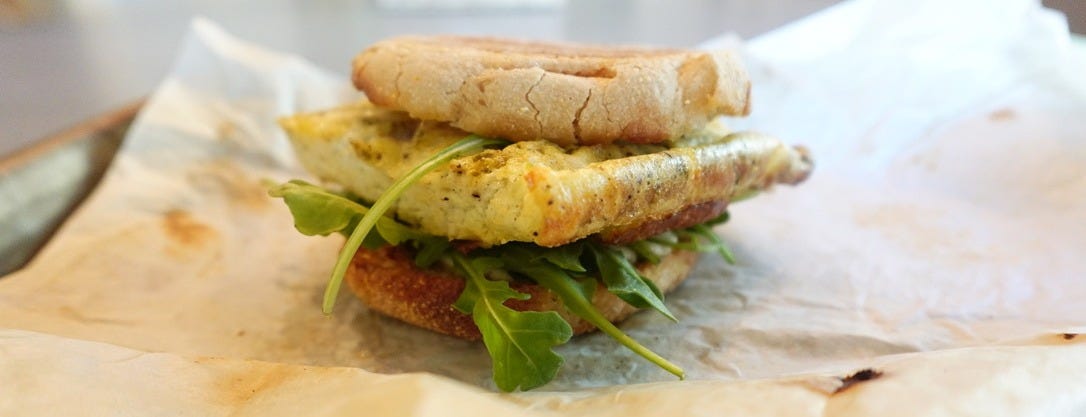
Pesto Egg Sandwiches
Let’s use up the rest of that jar of pesto from last week’s sheet pan meal. Pesto is such a bright, fun flavor for summer and it keeps this sandwich very veg forward.