Not all protein is created equal
What the label doesn't tell you about protein quality...

You have been peer pressured into eating more protein in your 30s and 40s than you ever were to do anything questionable in your teens and 20s. The pressure isn’t entirely wrong (I mean some of it is wrong, you don’t need 200g/day...) But before you start chugging protein shakes with every meal, let’s talk about why we actually eat a high-protein diet, because once you understand the why, it becomes really clear when a supplement actually makes sense and when you’re just expensive-urine-ing your money away.
Let’s go back to the 3 main reasons we eat a high-protein diet to start with… If you’ve read these before, bear with me, I promise I’m leading you somewhere.
The 3 Reasons we eat a High-Protein Diet
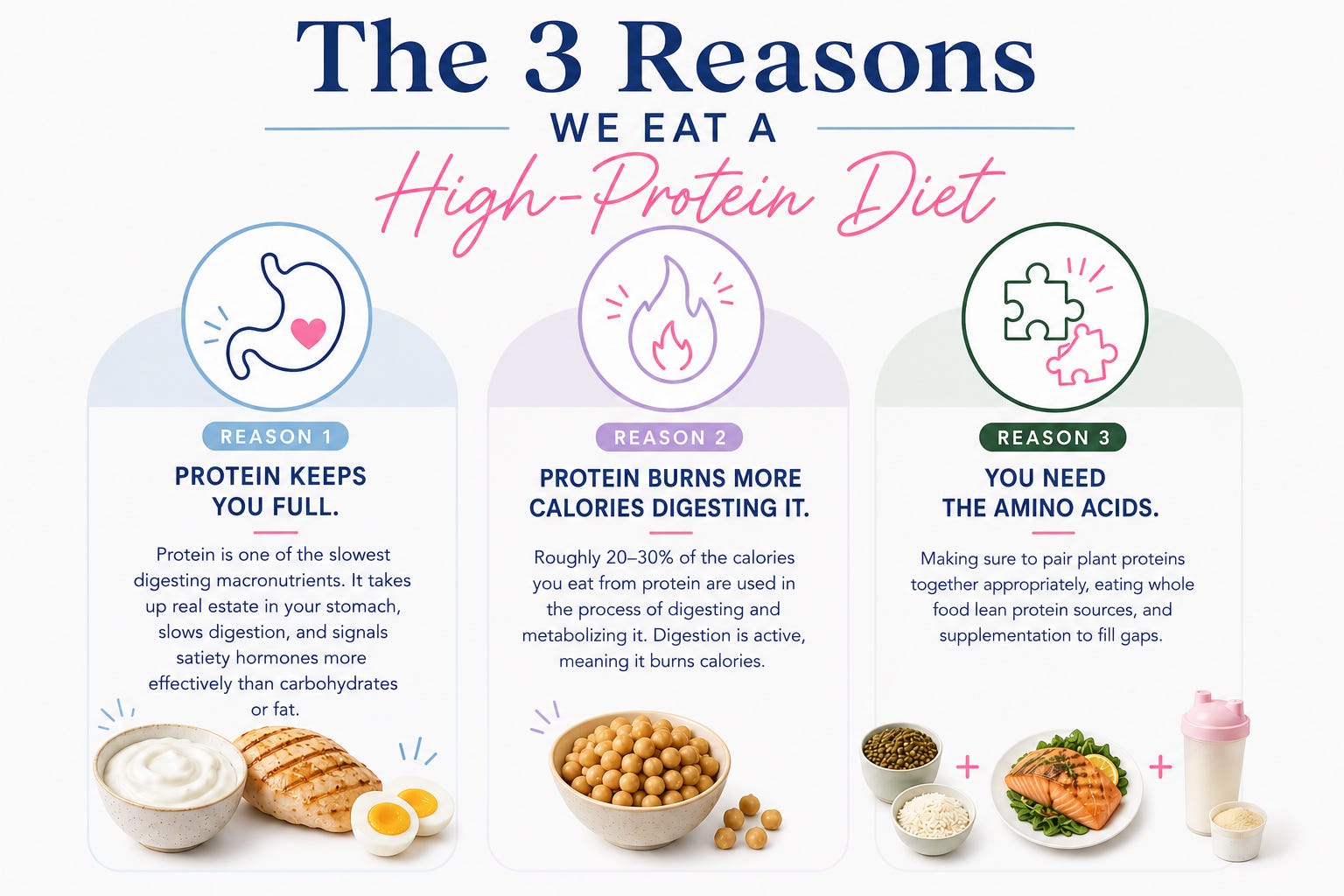
Reason 1: Protein keeps you full.
Protein is one of the slower-digesting macronutrients. It takes up real estate in your stomach, slows gastric emptying, and signals satiety hormones more effectively than carbohydrates or fat. It is a genuinely powerful hunger management tool, but only when it’s eaten as whole food.
Reason 2: Protein has a high thermic effect of food.
Roughly 20-30% of the calories you eat from protein are actually burned in the process of digesting and metabolizing it. Digestion is not a passive process, it is active, meaning it burns calories. (This is why eating too late at night can keep you awake- your body can’t fully rest when it is working on digestion.) This is one of the reasons a higher-protein diet supports body composition, not just because of the muscle stuff, but because of the metabolic cost of processing it. Again, this works best with whole food protein sources that take time to digest.
(side note: Both of these reasons are also why protein is not a great fuel source pre-workout, it takes time and takes the energy (calories) you could be using toward your exercise to push yourself just to digest the protein.)
Reason 3: You need the amino acids.
Your body needs a full set of essential amino acids (the ones it cannot make itself) to build and maintain muscle, manufacture hormones, produce enzymes, and synthesize neurotransmitters. This is the structural and functional side of protein.
Here’s the thing: to fully harness Reasons 1 and 2, you need whole food protein. Chicken, Greek yogurt, cottage cheese, eggs, legumes, lean beef, foods that take time to digest, occupy your gut, and keep you satisfied. A protein shake does not do that as effectively. It absorbs fast, clears your stomach fast, and doesn’t keep you full.
But Reason 3? That’s where a supplement can legitimately pull its weight. Because Reason 3 is about amino acid availability, and that comes down to the quality of the protein you’re eating, not just quantity and processing level.
So how do we know if a protein is ‘high quality’? I’m so glad you asked!
Why 20g Doesn’t Always Mean 20g
Here’s something the nutrition label doesn’t tell you: not all protein is equally usable by your body. Two foods can both say “20g protein” and deliver very different amounts of amino acids your muscles can actually use.
Two things determine this:
The amino acid profile: does this protein have all nine essential amino acids, or is it missing pieces?
Digestibility: how much is actually absorbed?
Think of amino acids like puzzle pieces. Some proteins come with the full set. Others are missing a few. And a protein missing a key piece can only be used up to the level of its most limited amino acid, regardless of what the label says.
Of all the essential amino acids, leucine is the one that matters most for muscle. Leucine directly activates a pathway called mTOR, which signals your muscles to build and repair. Without enough leucine at a meal, that switch doesn’t fully flip.
The threshold for younger women is roughly 2.5-3g of leucine per meal. For women in perimenopause and beyond? That threshold rises to 3-4g per meal, because aging muscles become less responsive to the same protein signal, a phenomenon called anabolic resistance. Your muscles don’t stop responding, they just need a stronger nudge. Rude, but workable.
How Do We Actually Compare Protein Quality?
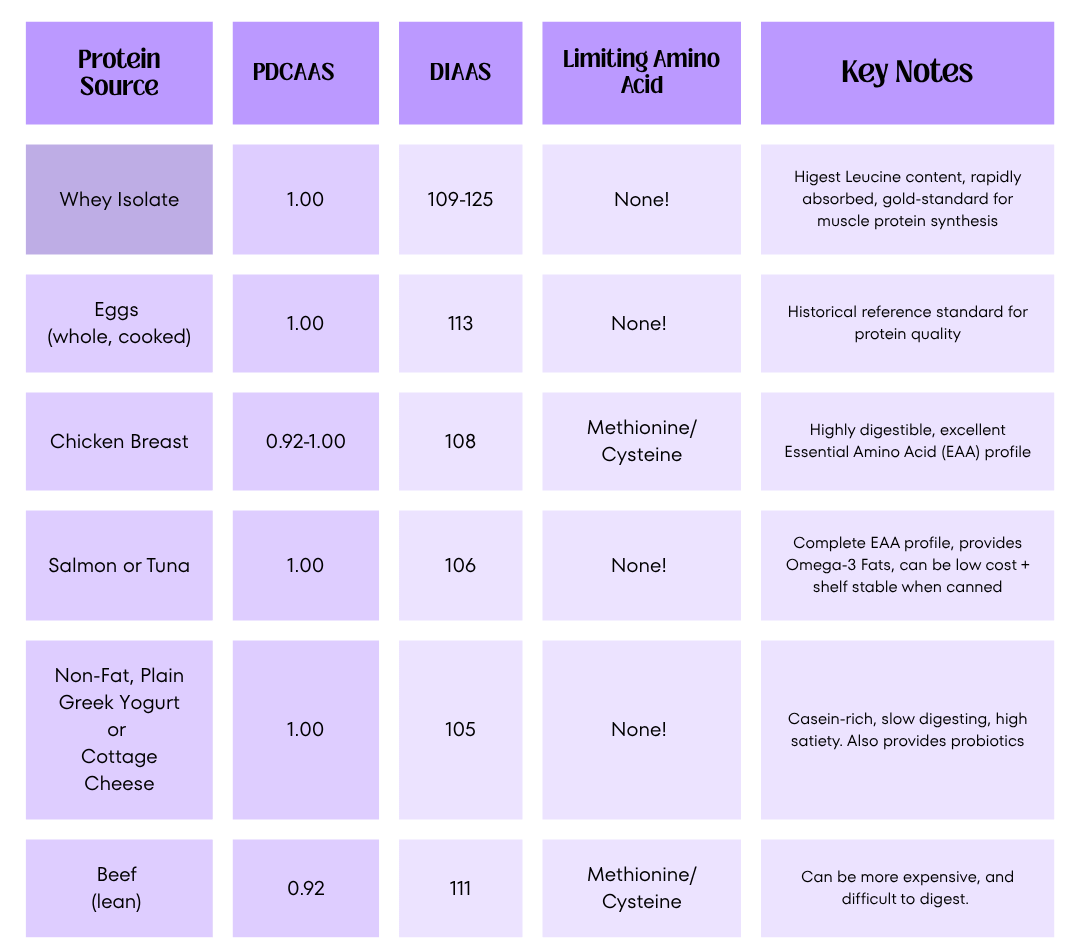
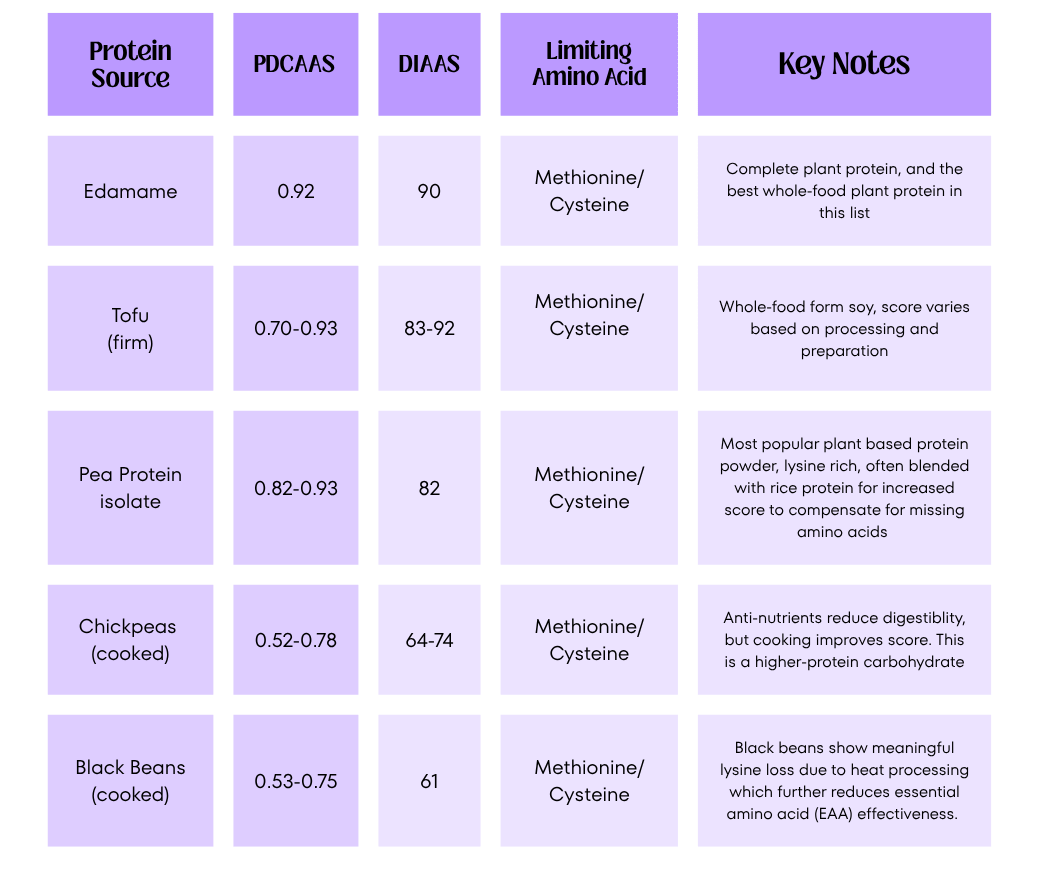
Scientists have a scoring system for this called PDCAAS (the Protein Digestibility-Corrected Amino Acid Score). It scores protein on a scale of 0 to 1.0 based on both amino acid completeness and digestibility. A score of 1.0 means the protein is complete and highly absorbable.
Quick reference:
· Animal-based proteins and whey and or casein: 0.92-1.0
· Plant-based proteins: 0.52-0.93, depending on the source and preparation
This means a 20g serving of protein from chickpeas delivers meaningfully less usable protein than 20g from Greek yogurt, not because the label is lying, but because the amino acid profile and digestibility are different. (And this can vary even further person to person depending on the health of your gut and your microbiome, but per usual I digress...)
Most plant proteins are also lower in leucine and may not hit the threshold that triggers muscle protein synthesis at a typical serving size. To match the leucine in a serving of chicken or whey, you’d often need a considerably larger portion (with more total calories to go with it.) It isn’t impossible to do, but it does require more planning and intention. Plant based proteins are great for Reasons 1 and 2, they keep you full longer with fiber
My job is literally nutrition and thinking about food all day long, and I don’t have the time to plan this meticulously, so I’m guessing that you may not have that time either.
Some protein information for common animal-based protein foods
Some protein information for common plant-based protein foods
Animal vs. Plant: Not a Competition, But Context Matters
Animal proteins (think chicken, fish, eggs, dairy) are complete, leucine-rich, and highly digestible, typically 85-97%. For muscle building and maintenance, especially in midlife when the leucine threshold is higher, they are the most efficient delivery vehicle.
Plant proteins bring fiber, antioxidants, phytonutrients, and real cardiovascular benefits that animal proteins simply don’t offer. I still want plants to be the star of your plate. But relying on them alone for your protein, without thoughtful pairing, makes hitting leucine thresholds harder, especially if you’re in a caloric deficit or your appetite is running lower than usual. This is a challenge when building muscle is the goal. It might be a bit easier if you’re maintaining the muscle mass you have, but it still takes effort.
The workaround is pairing complementary plant proteins: legumes (high in lysine, lower in methionine) with grains (the reverse- lower in lysine, high in methionine) to create a more complete amino acid profile together than either does alone. Rice and beans. Lentil soup and bread. Hummus and pita. Classic combinations that work nutritionally, not just culturally.
My personal approach: most of my meals are built around legumes, grains, and vegetables, and I add around 2-4 oz of chicken, turkey, or a lean cut of beef to close the protein gap efficiently. The plants are the star, the animal protein is the supporting actress.
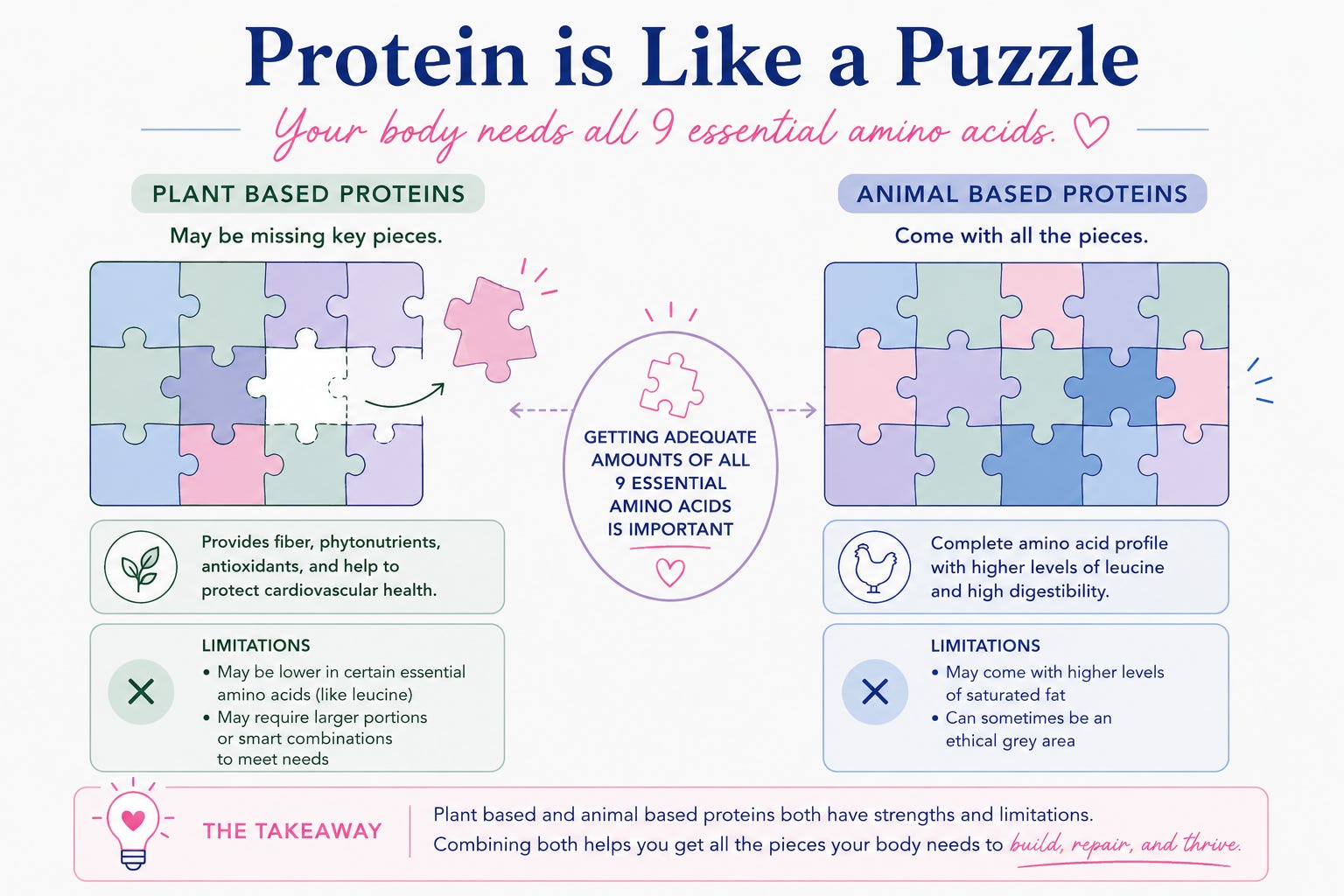
The best approach isn’t either/or. It’s combining both.
Plant proteins for their fiber and cardiovascular benefits, high-quality animal proteins for efficient, leucine-rich amino acid delivery. Think of plant proteins as valuable nutritional additions, not as reliable standalone muscle-builders when used in smaller amounts.
So When Does a Supplement Actually Make Sense?
I’m gonna say this loud and clear, I find protein supplements most useful when they are added to real-food meals, not in place of them. A protein powder on its own is not a meal. It is not going to keep you full (see Reason 1 above), and it isn’t balanced (balanced means the meal includes multiple food groups in appropriate ratios for our nutritional needs. Balanced meals keep you much more full and satiating as compared to single-macronutrients ‘meals’ like a protein shake.)
And here’s something that doesn’t get talked about enough: when you drink a protein shake without adequate carbohydrate alongside it, your body may not actually use that protein for what you want it to do. Remember gluconeogenesis?
Here’s the quick version of why that matters. Your body always prioritizes keeping your body and brain functions with energy (aka calories, aka glucose if we are being specific). If you haven’t eaten enough carbohydrates at a meal or snack, your body can actually convert protein into glucose for energy instead of using it for protein jobs like repairing tissues, a process called gluconeogenesis. Which means the amino acids you were hoping would go toward building and maintaining muscle end up being burned as fuel instead. Protein powder, eaten alone as a “meal,” is a setup for this. (This is also why I cringe a little when I see people using protein shakes as full meal replacements while wondering why they’re losing muscle and feel like shit. You need carbs to build muscle. Period.)
A supplement is exactly what the name says it is: a supplement to your diet, not the backbone of it.
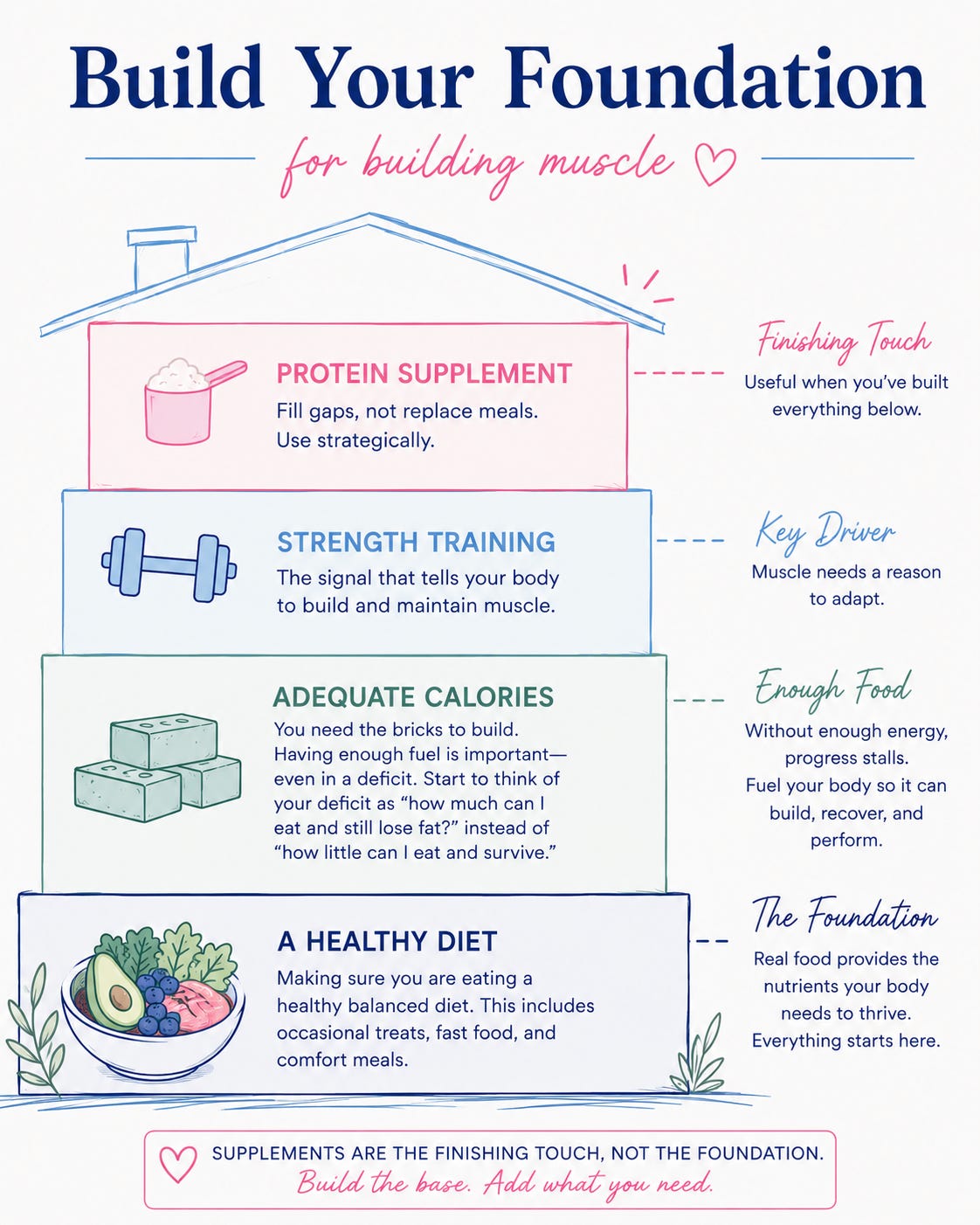
And if you are consistently needing more than one serving of a protein supplement (and yes, this includes bars, shakes, and powders) most days to meet your protein goals, one of two things is likely true: your protein goal is set too high, your overall dietary pattern needs a look, or both. One serving per day, added strategically to fill a genuine gap, is where protein powder earns its place.
Where it actually works well:
A busy morning where you’re eating real food but need more protein in the meal. A bowl of oatmeal with a scoop stirred in. Two pieces of avocado toast with a shake on the side. A high-quality protein bar paired with a piece of fruit when you’re genuinely on the run. Even a bowl of cereal with a supplement mixed in (or the shake poured in as the “milk”). These are situations where the supplement is adding to a balanced meal or snack, not replacing it.
Post-workout is another solid use case, particularly because your muscles are primed to use amino acids in that window and you may not have a full meal ready. But even then, pairing it with something, a banana, some crackers, a piece of toast, helps ensure that protein goes toward muscle repair rather than your energy needs.
Where it may be less useful: blending a scoop into a protein cookie or a brownie to make a dessert feel virtuous. (I say this lovingly, but we both know that’s not what the supplement is there for.) You can still do this to help increase your protein intake, but I find this just gives foods a health halo that they don’t deserve. The goal is to build high-quality protein around already quality foods, not to sneak it into things that aren’t really doing the work on the other side. It’s here to fill in the gaps. Not to be the main feature. And in my humble opinion, if you’re gonna have a cookie, don’t yuck it up with protein powder, just eat a cookie and enjoy it!
Why I Recommend Naked Whey Iso Specifically
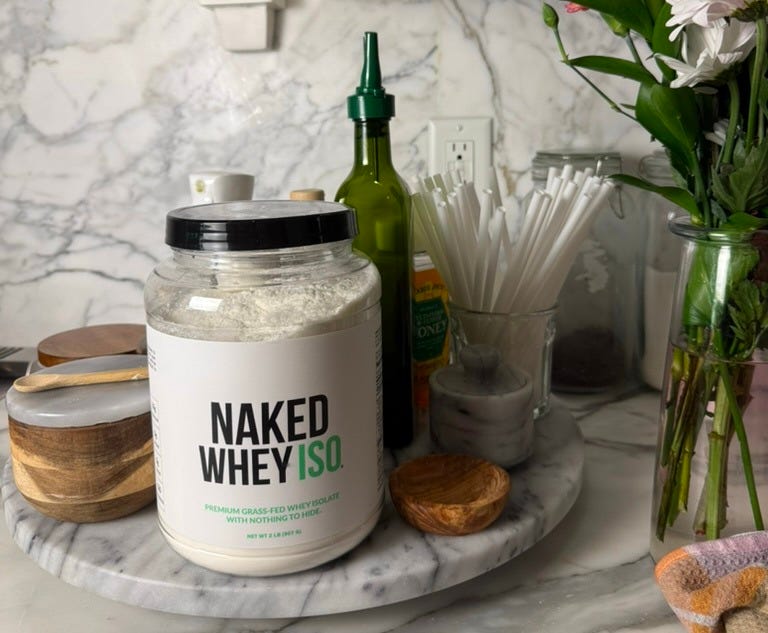
When I recommend a protein powder, I’m looking for a high-quality whey isolate from a company that keeps it simple. No proprietary blends, no ingredient lists that require a PhD to decode. Iso is short for isolate, and a Whey Protein Iso means that it is made strictly from whey (the watery stuff you see on the top of greek yogurt). This means it is lower in fat and carbohydrates than a traditional whey protein. It is also naturally lactose free (great for my lactose intolerant girlies!). Whey isolate is about as close as we can get to a pure protein food. It is higher in protein, lower in calories, easier to digest without lactose, and fast-absorbing making it my choice in a supplement. Here you are really getting what you’re coming for- protein, and leaving all the other junk behind. (Think things like artificial sweeteners, filler, gums/emulsifiers, color, flavors, etc. Not that these are bad, but I don’t necessarily want them if they aren’t needed.)
Naked Whey Iso is my recommendation for a few reasons:
It’s one of the highest natural sources of leucine, approximately 8-11% leucine by content, higher than casein, egg, soy, or pea protein. One serving provides roughly 2.5g of leucine, compared to about 1.5g from a typical plant protein blend at the same dose. That difference is meaningful when leucine thresholds are your target.
PDCAAS of 1.0. Naked Whey Iso has a complete amino acid profile, nothing missing, nothing to compensate for.
Minimal ingredient list. The flavored versions use fermented Reb-M from stevia rather than artificial sweeteners, which matters for people who experience bloating or GI sensitivity with artificial sweeteners like sugar alcohols. With less than 0.1g of lactose per serving, it’s also well-tolerated by most people who don’t typically digest dairy well.
Third-party tested. Purity and label accuracy verified independently. Non-negotiable for any supplement I recommend.
30g of high-quality protein per serving with minimal carbohydrate or fat, meaning you get the rest of your nutrition from actual food, which is exactly how it should work.
The unflavored version of Naked Whey Iso is my favorite for adding to food without changing the flavor profile, and without adding unnecessary sweeteners. You guys know I’m not against artificial sweeteners, I love me a Diet Coke, but moderation means choosing when to use them when it matters the most.
The Bigger Picture
Muscle is not just a fitness and aesthetics topic. (although it helps with both) It is a health and longevity topic, and for women, one of the most underappreciated ones.
Muscle mass drives your resting metabolic rate, helps regulate blood sugar, supports bone density, influences your energy levels, and predicts your physical independence later in life. (It also means you can get off the toilet by yourself for longer, and I will keep saying that until people take it seriously.) Sarcopenia (age-related muscle loss) starts in your 30s and accelerates through perimenopause and beyond. The earlier you take protein quality seriously alongside consistent strength training (eating enough protein is not enough to build or maintain muscle, you have to lift weights too), the better positioned you are for your 40s, 50s, 60s, and beyond.
You don’t need to overhaul your diet. You need to make intentional choices with what you’re already eating.
Simple Takeaways
Real food protein first, always. Chicken, Greek yogurt, eggs, cottage cheese, fish, legumes, whole grains, seeds, nuts- these are your foundational foods. They keep you full, support your metabolism, and deliver amino acids. A shake or powder does not replace them.
Check the source, not just the grams. 30g from a high-quality complete protein is not the same as 30g from a lower-scoring plant source.
Aim for 25-35g of protein per meal. If the meal is fully plant-based, aim for 35-45g to account for lower digestibility and amino acid completeness. Spreading protein throughout the day matters more than hitting a big number once.
Think leucine, not just protein. Target roughly 2.5-3g of leucine per meal (and closer to 3-4g if you’re in perimenopause or beyond) as the signal that actually drives muscle protein synthesis.
Use Naked Whey Iso to add to real meals, not replace them. No more than one serving per day, alongside or mixed in with real food that already has some quality carbohydrate and fat in it. If you’re consistently needing more than that to meet your goals, let’s look at the overall picture first.
Any other questions or topics you’d like to see covered? Let me know in the comments!
If you’re enjoying this Substack, please consider liking, commenting, sharing, or restacking this post. Subscriber support helps make this work possible.
Restacking shares the post with your followers, likes help boost visibility, and sharing by text, email, or Instagram helps more people find my content. Leave a comment and let me know what you’re loving (or what you’d like more of!) so I can continue creating content that’s actually useful.