

Functional Foods
Macro Math isn’t the same as healthy eating, and let's stop pretending it is.

Today I want to talk about the rise in functional foods and how to differentiate between the types currently on the market.
There has been a steep rise in health claims on grocery store packaging. Foods that promise a specific nutrient in isolation, like David protein bars, or low-sugar versions of naturally high-sugar foods, like keto ice cream. While these foods can be helpful in some contexts, they are typically extremely processed and highly engineered to meet certain goals.


As a registered dietitian, I see lots of people relying on these foods to meet their macronutrient goals, especially protein and fiber. If ultra-processed foods are the base of your diet, it becomes difficult to achieve good health, even if the numbers fall in line in your macro-tracking app.
A functional food is a food that provides benefits beyond basic nutrition due to naturally occurring or added bioactive compounds. These foods are modified, fortified, or enhanced to provide benefits beyond just calories.
I like to break functional foods into three categories.
1. Naturally Functional Foods
These are foods that inherently provide health benefits. Nothing has been added to make them powerful. They simply are.
Examples:
Oats contain beta-glucan, a type of soluble fiber that helps lower cholesterol and manage blood glucose.
Yogurt is a naturally fermented food that provides probiotics.
Fatty fish like salmon provide long-chain omega-3 fatty acids such as EPA and DHA, which help reduce inflammation, lower triglycerides, and support cellular function.
These foods are beneficial because of what they already contain.
2. Enhanced or Fortified Functional Foods
These foods have something added to improve their nutrient profile. Not all of these are bad, but the benefit is not naturally occurring.
Examples:
Milk or soy milk fortified with vitamin D.
Cereals fortified with folic acid.
Calcium-enriched plant-based milks.
High-protein yogurts that are filtered to increase protein content.
These foods are strategically modified to turn a mediocre source of a nutrient into a meaningful one.
I would argue that the first two categories can offer clinically meaningful benefits. Fortification, like adding folic acid to cereals, is a public health measure that helps prevent neural tube defects in early pregnancy. Enhanced foods can also help people meet specific health goals.
3. Macro-Engineered Foods
This term comes from Brittany Raftis, MSCFN, RD, who writes The Grocery Edit.
These foods are almost ‘reverse engineered’ to meet a specific macronutrient target from a product that does not naturally have those characteristics.
Think:
Quest protein chips. Chips are not naturally a protein source.
High-protein pop-tarts or cereals.
High-fiber tortillas, bagels, and breads.
Protein bars, drinks, and powders.
These foods are designed around a macronutrient goal first. The product is then created to fit that niche.
It can be difficult to tell the difference between enhanced foods and macro-engineered foods. The difference is that macro-engineered foods often rely heavily on marketing, isolated additives, and label appeal. They may inflate fiber or protein numbers without meaningfully improving overall health.


When I think about macro-engineered foods, I think about products packed with additives that use a selling point like high protein or high fiber to signal quality, even when the overall food matrix is poor.
There is something powerful about whole foods that we still cannot fully replicate. It is called food synergy. The health effects of a food come from the interaction of its nutrients, fiber types, plant compounds, and physical structure working together.
A bean is not just fiber. It contains soluble fiber, insoluble fiber, resistant starch, polyphenols, minerals, and a food matrix that slows digestion and shapes nutrient absorption. This nutrient delivery system has yet to be replicated, and this works with lots of different foods. The probiotics in yogurt, kimchee, and sauerkraut, are delivered more effectively than supplements to our colon and tend to remain in our system.
When you engineer a tortilla and add isolated inulin or gums to boost the fiber number, you may increase grams, but you cannot recreate that complexity. Whole foods deliver nutrients in a coordinated way that affects satiety, blood sugar, gut bacteria, and inflammation differently than a collection of isolated additives.
More fiber or protein on the label is not always the same as more benefit in the body.
Protein and fiber from macro-engineered foods can help fill gaps. But they should not replace the foundation of your diet, which is still built on whole foods.
A few tips to identify which type of functional food you are using:
Ask yourself the following questions…
Would this food still be beneficial if I ignored the front label completely?
If I were to look at the nutrition label and ingredients list alone, does this sound like something I want to eat?
Was something added to improve a real nutrient gap?
Despite what RFK Jr. states, there isn’t a “war” on protein, and rarely is anyone deficient in protein.
Was this food built around a macro goal first?
Think products that mimic indulgent foods but emphasize macros. Lots of isolates and gums in the ingredient list.
Would this food naturally contain this much fiber or protein without engineering?
Start thinking of your foods in different categories. I am not saying that all fortified functional foods or macro-engineered foods are bad… they just shouldn’t be the basis of your day-to-day diet.
Category 1 = foundation foods, the things you eat on a regular basis (you see these in my meal plans!)
Category 2 = strategic support. I can’t always get 2 servings of fatty-fish per week, so eggs fortified with omega-3-fatty acids can help me to fill that gap.
Category 3 = convenience tools. This is where most macro engineered foods fall. If I’m on a road trip, a protein pop-tart might be my only choice!
Next week I am planning to discuss types of fiber. If this is something that interests you, subscribe so you can get the rant! Free subscribers will get the first part of my weekly newsletter, and paid will also receive the meal plan.
How to Use This Meal Plan
This is a guide, not a rulebook. It’s here to help you build balanced meals, not lock you into anything rigid. Swap ingredients, make changes, take what you need, and leave the rest.
This plan follows my OKP Signature Method, designed to make the healthy choice the easy choice.
Here’s the structure:
• One breakfast you prep once and eat through the week
• One lunch you prep once and eat through the week
• One consistent snack or dessert you can have through the week
• Three dinners that are balanced, satisfying, and actually taste good
You’ll see ingredients repeat, that’s intentional. These are foods that deliver lean protein, fiber, whole grains, nutrients, and flavor. If you don’t love something, change it. This is meant to be flexible.
These are the kinds of meals I eat week to week as a dietitian who focuses on feeling good, with enough variety to keep it interesting, but not so much that you need a brand-new grocery list every week.
There’s room for dinners out, pizza night, and the weeks when life happens. Follow it exactly, or use it as a template and make it your own.
Simple. Sustainable. Balanced. Delicious.
What you’re going to do
One (or two) days per week, I prefer Sunday, you are going to prep your breakfast, lunch, and snack/dessert. There is optional prep you can do to make dinners faster, but you don’t have to do this.
The purpose of having your breakfast and lunch ready to go is making this healthy choice the easiest choice. When it’s easy to grab and ready to go- the decision of what you are eating has already been made, now all you have to do is eat it.
Lean in and enjoy the process.
Breakfast: Tiramisu Overnight Oats
I saw this recipe on Cooking For Peanuts on Instagram for Tiramisu overnight oats and was gobsmacked. What a great idea, getting a little coffee boost with my breakfast is always a plus for energy levels. Nisha, the creator of the original recipe, is an RD and a gourmet vegan chef so you know her recipes are next level.
I did make some tweaks to the recipe to increase fiber, increase protein, and incorporate some animal products (like milk and traditional greek yogurt) but the sentiment is the same.
The changes I made were
Double the recipe to make 5 servings at once rather than 3. By making 5 servings I also ensured that we are getting adequate energy in the morning. No 150 calorie breakfasts for us. OKP Girlies know that eating 60% of your daily energy needs (aka calories) by the end of lunchtime helps manage our weight and keep our metabolism running on all cylinders.
Swap soy milk for Fairlife Skim Milk. Fairlife milk is ultra-filtered to have more protein and it is lactose free. If you are lactose intolerant than Fairlife will work for you! Otherwise soy milk is the next best choice- it has protein, fat, fiber, and phytoestrogens and isoflavones which benefit health too. A third choice would be Ripple Pea Milk. You can use any milk, truly, but these will give you the biggest nutritional power.
Added chia seeds for fiber and healthy fat. If you’re using skim milk, you have eliminated the saturated fat in this meal, which is great, but we do need some fat to feel completely satisfied. Chia seeds are adding omega-3 and omega-6 fatty acids, as well as fiber and making our oats nice and firm.
Swapped plant based greek yogurt to traditional greek yogurt. Nothing is wrong with plant based, but traditional is higher in protein, lower in fat, and has animal protein which is more bioavailable for absorption.
You can also get these higher protein rolled oats to use, I recently started using them thanks to the recipe suggestion and they are wonderful!
If you want to add a sweetener to the oats, feel free! My husband didn’t find them sweet enough, so feel free to add some honey, stevia, sucralose, or even sugar to meet your taste-buds where they are at.
I hope you enjoy these as much as I did. To dust with cocoa on top, use a small mesh colander to put the cocoa powder in, and then gently tap with the heel of your hand to distribute evenly.
Lunch: Winter Kale Salad with Tahini Dressing and Mommy’s Special Chicken
Ok I know it is march, but the groundhog saw his shadow this year so technically winter doesn’t end until March 20th. So I want to get this simple, yummy, balanced salad in one more time before we say hello to spring.
The salad and dressing are wonderful- but today I want to talk about the chicken. I have so many clients who get the “chicken ick,” and I 100% sympathize with them because chicken can be absolutely disgusting if it isn’t done correctly. I don’t want to see any stringy, chewy, or gross pieces. It has taken me years to perfect Mommy’s Special Chicken and now it is my job to pass the technique on to you all. This chicken isn’t gross reheated, isn’t gross cold, doesn’t have any chewy or mushy texture, and it all comes down to the brand of chicken and the technique.
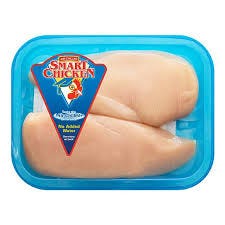
You have to get Smart Chicken if it is available at your local grocery store. This chicken is so good, I don’t know what they do to it (and I don’t want to know) but it is homogenous in texture, has very little gross sinewy bits, and isn’t covered in slime. Other people swear by the chicken breasts at the deli counter in the local store, and I will agree that those are the second best. Get this chicken if you are easily grossed out by chicken. I like to get four breasts to last ME the entire week. Yes, this is mommy’s special chicken- not family special chicken.
The next step is to get a marinade you like. I am partial to the Stubbs Chicken Marinade or the Stubbs Pork Marinade. It really doesn’t matter, but get something you like, that isn’t loaded with sugar (less than 5 g is ideal). If you don’t get a marinade, pour about 2 tbsp of olive oil, 1 tsp kosher salt, and 1/2 tsp black pepper into a gallon ziplock freezer bag.
Put two breasts into each gallon ziplock baggie, and pour in 1/2 the bottle of marinade into each bag. Now you are going to take out your pent up aggression on the meat. You need a meat mallet, but a can or heel of a shoe could work in a pinch? Now pound that chicken out until it is about 1/4 inch thick, and there is an even thickness. Do this to all of the breasts.
If you planned ahead well, you should let this soak in the fridge in the marinade overnight, if not, 30 minutes will do. The longer the better.
Preheat your oven to 400 degrees Fahrenheit. We don’t want mushy, wet, sloppy chicken so that oven needs to be hot. Take a sheet pan, and put down a layer of parchment paper to make clean-up easier (this is optional, nothing else in the process is.) and then on top of the parchment lay a wire grate. Like a cooling rack. You need this so the liquid drips off of the chicken. It is crucial.
Lay the chicken on the grate evenly (its ok if they overlap a little bit) and bake for 45-50 minutes. Maybe even 60. You want this stuff cooked. I promise it isn’t too long. Take it out, and let the chicken cool, and put it in the fridge in a glass storage container. Once it’s cool, slice, dice, and eat however you want! I swear to god this is the best way to make chicken.
If you are organized, I like to marinade and pound thin, and store in the freezer. I lay them flat (like a sheet of paper) so they thaw quickly and then I am ready to bake at a moments notice! I have never tried baking from frozen, but I bet it would work with some extra time in the oven.
Anyway, if you are grossed out by chicken breast- that journey stops here. I promise this chicken is good.
Making a neutral protein source is always a great step toward a more organized week of eating. The protein source is usually the part of the meal that takes the longest. Even if I don’t know what I’m making for lunch, I make Mommy’s Special Chicken and I can use a bagged salad, a wrap sandwich, a quesadilla, frozen veggies + rice + chicken with a sauce, there are so many options that come together quickly and easily, and with a delicious lean protein source ready to go my balanced meals have become so much easier to create.
Snack: Two oranges + a string cheese
Simple. Balanced. Nourishing. Effective.
Did you know the majority of adults in the US don’t eat enough fruit?
Did you know oranges are the 4th most satiating food?
Now you do.
A snack should be a protein/fat source paired with a carb, and thats what we are doing here. Oranges are in season for a couple more weeks, if you can get your hands on some sumo citrus oranges those are the best!
You could swap a cheese stick for a chomps stick, some nuts, trail mix, nut butter packet, yogurt, or even a protein bar. I know, I usually hate those but a snack is really the only place I find them appropriate.
What’s for Dinner?
Crockpot Honey Korean Chicken Noodles
This chicken is so good. I am serving this with a side of steamed green beans to make sure it is balanced.
Broccoli Cheddar Orzo with Chicken
This recipe is classic comfort food, but is also really good for you!
If you are eating a gluten-free diet, an easy swap for the orzo would be basmati rice! Just make sure you are doing a 2:1 ratio of liquid to rice, so if you add a cup of rice, add 2 cups of broth. Simple!
Now if you aren’t eating a gluten free diet, there are plenty of types of orzo to use. I prefer a whole-wheat orzo, so you are getting a bit of extra protein and fiber. You could also use any short-cut pasta shape, like bow-tie, penne, or even radiatore (I am recently obsessed with this shape, and with brami pasta, it’s similar to barilla protein+)
Some quick tips:
Get a bag of pre-shredded carrots. Come on, make your life easier.
Use Fairlife Milk (you already have it for breakfast 🙃) to easily up the protein a little bit- plus reduce fat (this recipe has plenty of cheese for fats!)
I use a frozen bag of broccoli florets, it saves a lot of time and is usually cheaper and more nutritious! a 10-oz bag will work (anything close to that size)
Mix all of the herbs on the weekend and save them in a baggie, then you can just dump it in day-of to be super quick!
You don’t need to use freshly grated cheddar, pre-grated will work just fine.

Sheet Pan Shrimp Burrito Bowls with Cilantro Lime Rice
These are so easy and yummy! You can even use frozen shrimp, and frozen peppers and onions. These come together so quickly, and you can customize with toppings. Shrimp is a great source of lean protein, and don’t worry about dietary cholesterol. Research shows that dietary cholesterol doesn’t correlate with serum cholesterol (aka the cholesterol in your blood) so eat up and enjoy!
I want to thank you all for being subscribers, and I truly hope this meal plan makes your week a bit easier and helps your nutrition feel like less of a burden and more like self care. Eating well is taking care of yourself!
XO
Kate, your RD bestie