


One of the best ways to manage your nutrition and health is by cooking at home.
But what if you want amazing asian takeout?!
For a long time I was super intimidated by cooking asian food- whether it was Indian Curry, Korean Bibimbap, Japanese udon noodles, or Chinese dumplings. Pan-Asian food is some of my favorite (truly if I could pick one cuisine for the rest of my life it would likely be some type of asian food) but I do not love the feeling after a night of takeout (neither does my wallet…)
Cooking at home makes sure that I am getting all the nutrients I need in the proper ratios. Restaurants tend to skimp on the protein and veggies, as they are the most expensive parts of the meal, and load up on the carbs and oils, because they taste the best! They also aren’t typically using whole-grain carbohydrates or high-quality oils because that would cost more, and likely won’t make the food taste a ton better.
My whole family absolutely loves dumplings, but none of us have the time or patience to sit there and stuff them one by one. We are more of an instant-gratification type of crew, if I’m being honest… but I had been seeing “pork dumpling noodles” trending on TikTok and Instagram and I wanted to make my own version to see if I could pull off the feat we are all going for..
making a meal that my whole family will eat.
Well, I didn’t get Willie to eat it, but 3 out of 4 isn’t bad!
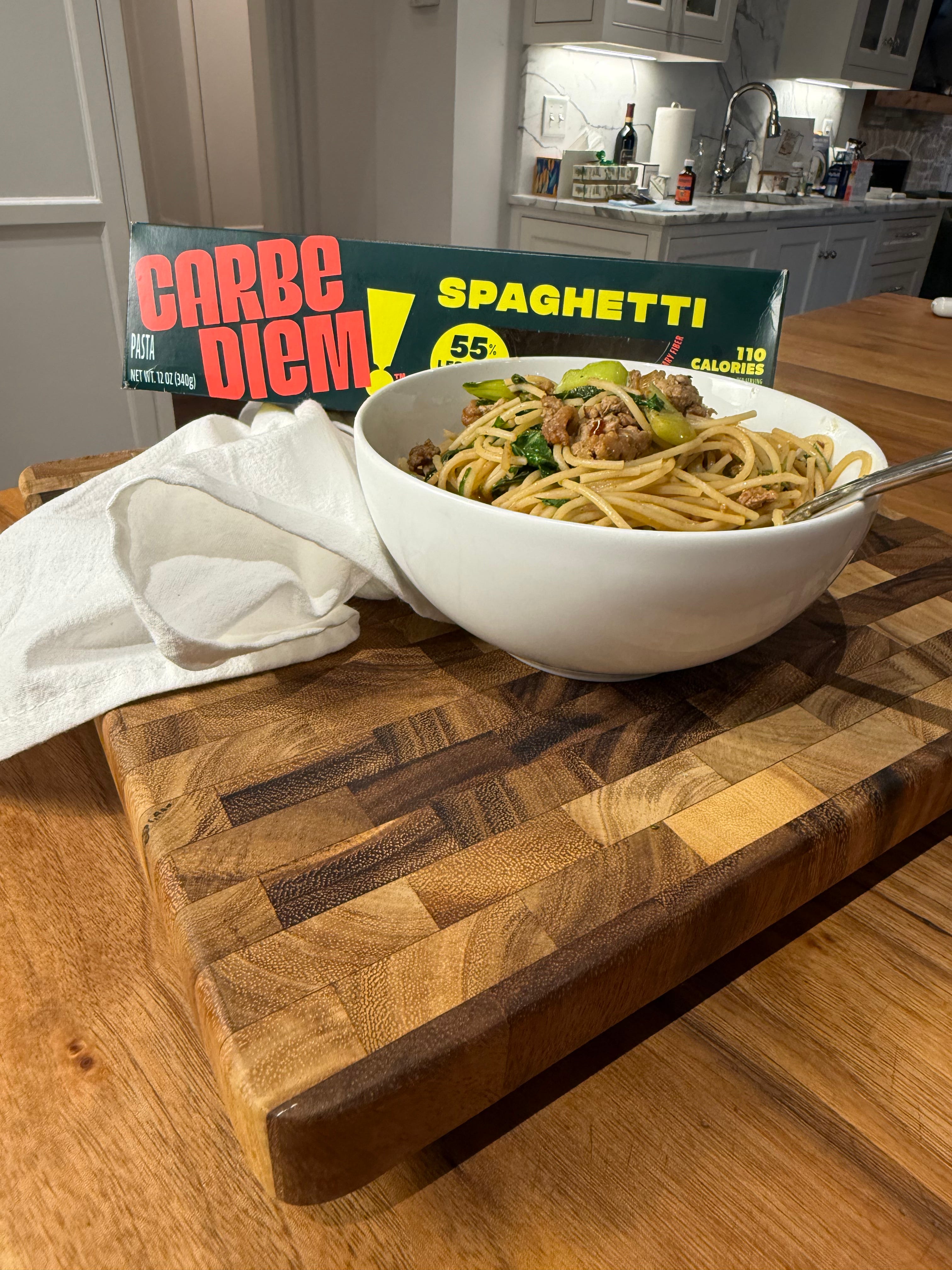
I was gifted a box of Carbe Diem pasta, and while you can use traditional ramen, instant ramen, or udon noodles to make this dish, you can also use regular old spaghetti, which makes one less hoop to jump through to get all your ingredients together. I thought this would be the perfect place to try this high fiber pasta.
Carbe Diem uses resistant starch technology to increase the fiber content of the pasta. I am sure you have heard about this phenomenon before. If you cook white rice or potatoes, and then cool them, and then reheat them to eat, you have created resistant starch! Resistant starch is created when a regular starch molecule is modified by cooling, heating, or pressure to change the formation of the starch molecules, making them more difficult to break apart with our digestive enzymes.
Now the starch has become resistant to digestion, and functions more like fiber! There are varying degrees of resistant starch created, but Carbe Diem has a proprietary method that they use to create their pasta.
This is the type of fiber that actually feeds your gut microbes, and can also be called a pre-biotic. These types of fiber are really important because our gut microbes need this fuel to survive and create a healthy gut microbiome. Also, when the microbes digest the resistant starch, their waste product is a short-chain-fatty-acid (SCFA.) SCFAs are so important because they are extremely anti-inflammatory molecules that float around the body and reduce inflammation.
Now listen, you don’t want to overdo it on the prebiotics. Too much of a good thing is not good- trust me, I am a maximalist at heart and I have to restrain myself in every aspect of life, including with how much fiber I eat. Too much, and you’re looking at bloating, farts, urgent trips to the bathroom, or even constipation.
You can also increase the fiber in this dish by simply using whole wheat pasta, chickpea or lentil pasta, or protein pasta. But while all of those have an increase in fiber (between 6-9 grams per serving) they don’t come close to the 24 grams in Carbe Diem.
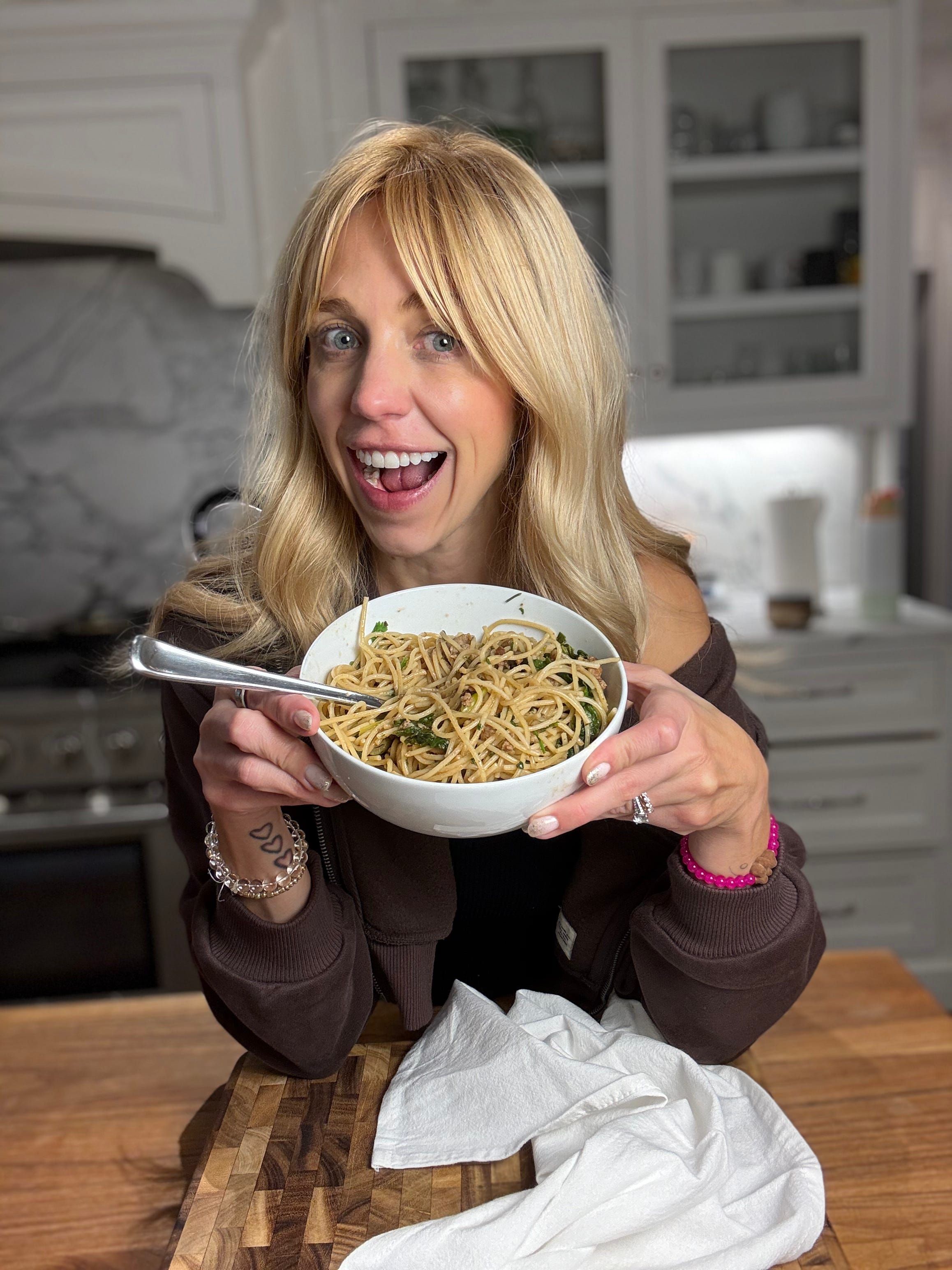
Ok so now on to what you are all here for… the recipe
Kate’s Better-Than-Takeout Pork Dumpling Noodles
Serves 6
1 1/2 pounds ground pork
1 bundle scallions, chopped
1 1/2 tsp garlic powder
1 1/2 tsp onion powder
1/4 tsp white pepper
1 tsp sugar
3/4 tsp Chinese Five Spice
1 tsp salt
4 tbsp soy sauce
1 tbsp oyster sauce
2 tsp sesame oil, divided
1 tbsp rice vinegar
4 cups bok choy, roughly chopped
1/2 cup cilantro, roughly chopped
12 oz whole wheat spaghetti, cooked according to package or use Carbe Diem Pasta
Heat up one teaspoon of sesame oil in a skillet or wok. Use this to cook the ground pork. Season the pork with ~1 tsp of kosher salt and a dash of pepper.
While the pork is cooking, boil a pot of salted water and cook the pasta according to directions on the box. Reserve about 1 cup of the starchy pasta water.
Add the scallions into the pork, and cook for 1-2 minutes.
Mix together the spices (the garlic powder, onion powder, sugar, ginger, Chinese 5 spice, and white pepper [or regular pepper is fine]), and in a separate bowl mix together the sauces together (soy sauce, oyster sauce, 1 tsp sesame oil, rice vinegar, and chili crisp)
Roughly chop the bok choy, making sure to wash well (these can be really dirty!)
Add the sauce and spice mixture to the pork and scallions. Stir to combine. After about a minute, add the bok choy and stir to combine. Let to cook for 3-5 minutes, until the leaves are wilted. Don’t overcook!
Add the cooked noodles to the pan with the pork and veggie mixture. Mix well to combine. Add a little bit of pasta water to thin the sauce, and help it stick to the pasta. Turn off the heat, and stir in the chopped cilantro.
Divide into 6 portions and serve with extra scallions and cilantro for garnish. enjoy!
Notes:
If you eat a gluten free diet, you can use a GF noodle, or rice noodles, and substitute tamari for soy sauce (that is what I always use!)
You could try using a different type of ground meat if you don’t like pork, but make sure there is SOME fat in the meat (don’t use 99% lean ground turkey) the fat is what helps to cook down all the veggies and actually makes this dish satisfying. I get the “leaner” ground pork from my local grocery store.
Feel free to add in extra veggies you have lying around, some shredded cabbage, sugar snap peas, or red bell pepper (my fav) would also be great.
If you like extra spice, don’t be shy with the chili crisp!
If you like LOTS of sauce, double the sauces to make it extra saucy. (I am not a sauce girlie so don’t come at me.)
Don’t skip the pasta water! It makes such a big difference in the texture of the dish.
This is GREAT as leftovers, just like all takeout Asian noodle dishes are… so make a lot, and eat it for lunch the next day.

If you want the specific nutrition facts (aka macros…) they are listed here in the PDF! Keep in mind I used whole wheat pasta for the nutrition facts, so these will change if you sub in a different noodle!
I hope you guys enjoy this recipe created by moi! If you make it, take me on social media, leave a comment, or send me a message, I love to see you all in the kitchen!
Xo
Kate, your nutrition bestie